
Degenerative Disc Disease: Causes, Symptoms and Treatments

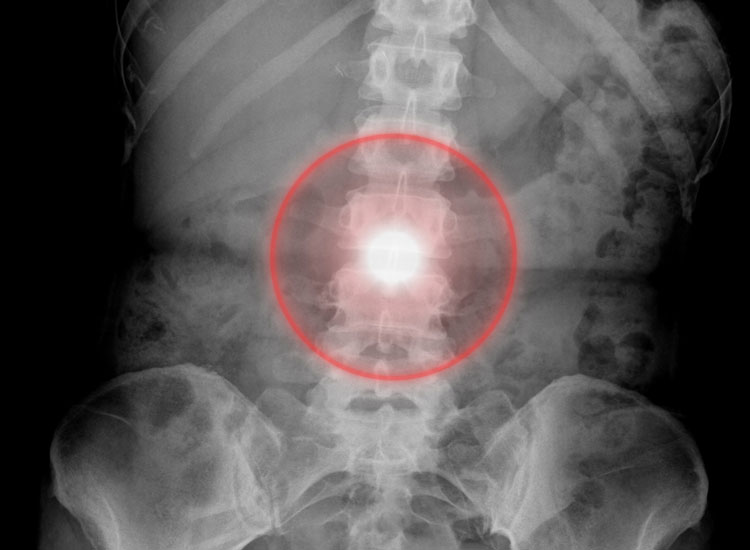
Getting older can be a real pain in the neck… and the back, too.
For many people, that pain can be caused when their bones and discs begin to deteriorate. We call this degenerative disc disease. It's also sometimes referred to as spondylosis.
Not everyone with degenerative disc disease will have severe pain, but you should know that it’s a common cause of both lumbar pain (low back pain) and cervical pain (neck pain), especially as you age. In fact, statistics show that 40% of people over the age of 40 suffer from some form of degenerative disc disease.
And that number increases to more than 80% for people over 80.[i]
It’s important to keep in mind that it’s possible to have pain from herniated discs or pinched nerves and not have excessive disc degeneration.
In this article, we'll cover the risk factors, causes, symptoms and of degenerative disc disease. At the end of this article, you will find recommended treatment options and provide a video showing spinal decompression stretches for back pain.
What Is Degenerative Disc Disease?
Degenerative disc disease (DDD) isn’t really a “disease” at all. But it’s the term we use to refer to the typical changes that take place in your spinal discs over your lifetime. Although degenerative disc disease can occur in any part of the spine, it most often occurs in the lumbar spine (your lower back) or the cervical spine (your neck).
It helps to understand what your spinal discs are and what they do…
Spinal discs are soft, compressible discs that separate the vertebrae. They serve as shock absorbers between the bones of the spine. These discs are designed to help your back stay flexible and sturdy.
They prevent injury or trauma that can occur when you perform daily activities… everyday movements like twisting, flexing and bending.
Think about how often you do these things… lifting your grandkids, swinging a golf club or tennis racket… even bending down to pick up something you dropped on the floor…
As you can imagine, your spinal discs experience a lot of wear and tear over the years.
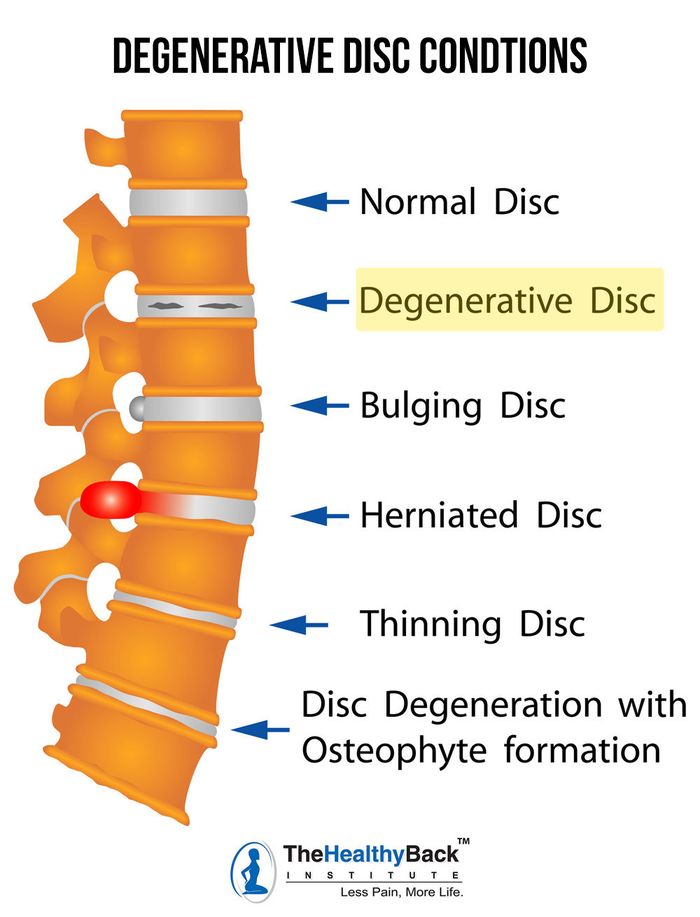
The discs start to break down. This breakdown can sometimes lead to degenerative disc disease.
Common Risk Factors for Degenerative Disc Disease
Unfortunately, it’s normal for disc degeneration to occur as we age. But there are some things that can accelerate the process, like:
- Tiny cracks and tears in the annulus (outer layer) of the disc. If this happens, the (disc) may be forced out through these tears. This can cause to rupture, bulge or break into fragments.
- Loss of fluid in discs that reduces their ability to act as shock absorbers and causes them to be less flexible.
Sudden injuries, such as car accidents, falls and sports injuries, and poor nutrition can also begin the degeneration process.
When there is less padding between the spaces in the vertebrae the spine becomes less stable. Osteophytes (bone spurs) can form as your body attempts to distribute weight more evenly after a disc has been damaged. These tiny bone outgrowths can end up irritating and damaging the nerves in your spinal column. This can be extremely painful!
Common Symptoms of Degenerative Disc Disease
Your pain levels are not a good indicator of how much disc damage you actually have. (And again, you could have damage and have no pain at all.)
But if you are experiencing pain, you’ll find that the pain is worst in the location of the affected disc.
If you’ve experienced lumbar disc damage or lower back pain for many years, you will experience radiating pain down your buttocks, thigh and knee. You may also have symptoms that include numbness or tingling in the legs and lower back. Sciatica is also a common symptom for those who suffer ongoing lower back pain.
If your symptoms include neck pain that radiates throughout the shoulders and arms, you may have cervical disc damage. These symptoms also include tingling and numbness in the neck and shoulder region as well as a decreased range of motion. This pain may worsen with long periods of sitting or poor posture.
Common Causes of Degenerative Disc Disease
Yes, aging is one cause of degenerative disc disease, but it’s not the only one. Regular wear and tear and excess movements can also contribute to DDD.
There are many lifestyle factors that can lead to conditions that cause degenerative disc disease. Even what you do for a living can play a major role. For example, people who work in physical industries like construction or sanitation are more likely to suffer from osteoarthritis or a herniated disc – both conditions that can lead to a deterioration of spinal discs.
Obese people and those who smoke cigarettes are also more likely to have symptoms of degenerative disc disease. It’s believed this is because they are more likely to lead a sedentary lifestyle.
Muscle imbalances – essentially, one set of muscles overpowering another – create “postural dysfunctions” that put abnormal pressure on a disc and cause increased wear and tear over time. Eventually, the weak spot gives way and makes contact with the nerve, bringing pain.
Here are some other conditions that can lead to disc deterioration:
- Spondylolisthesis: a spinal condition in which one vertebrae slips backward or forward relative to the next vertebrae. This condition can cause a compression of nerve roots and cartilage deterioration. In addition to causing pain to your sciatic nerve, this can lead to further deterioration of the spinal discs. Many of the symptoms of degenerative disc disease mirror those of sciatica. That’s partially because sciatica is one of the main symptoms of degenerative disease. Of course, this doesn’t mean that every person who suffers from sciatica will end up with DDD. Because of this though, there are several medical problems related to sciatica that can cause degenerative disc disease.
- Lordosis: a condition that occurs when the lumbar or cervical vertebrae (lower back or neck) column is partially curved. This can manifest as a weak leg or thigh, an area often affected by sciatica. This curvature can lead to spinal degradation over time, which may eventually lead to degenerative disc disease.
- Herniated disc: An abnormal bulge or bursting of a spinal disc. Even once a herniated disc has been fixed with surgery, the destruction to the disc will continue over time. Each movement you make over the years is slowly causing your disc to slowly deteriorate.
- Osteoarthritis: Also known as degenerative arthritis, this occurs when the cartilage between your joints breaks down. The cartilage can wear out because of daily wear and tear, aging, injury or misuse. When this occurs in the spine, your discs are not being protected or cushioned from general movement. This means that every step you take, every twist and bend is putting stress on your discs.
- Spinal stenosis: A condition in which the spinal canal narrows, compressing or “squeezing” the spinal cord and nerves inside. The narrowing also causes increased friction between your discs as you move. As the space decreases around the spinal cord, bone spurs will develop. These bone spurs (as I mentioned above) put additional pressure on the spinal cord and nerve roots.
Degenerative Disc Disease Treatment Options
Most doctors have a standard course of treatment for degenerative disc disease.
They'll perform a physical examination and reviewing your medical history to see if any of your daily activities could be causing your pain. They may check for muscle weakness and numbness, Then they'll likely order an x-ray, MRI (magnetic resonance imaging) or CT scan they'll likely suggest one or more of the following treatment options:
-
- Non-steroidal anti-inflammatory drugs (NSAIDs such as ibuprofen) and other pain medications
- Ultrasound
- Electrical stimulation
- Therapeutic exercises and physical therapy
Spine surgery is also an option, with the two main goals being to take pressure off the nerve and stabilize the joints.
Some of these treatments, such as ultrasound and hot packs, are conservative treatments. Others -- like cortisone injections and pain medications like ibuprofen -- are harmful to your health. They can have terrible – and potentially fatal – side effects. But most of them also FAIL — because they simply address your symptoms.
They don’t address the cause of your degenerative disc disease.
Conventional doctors focus on pain management,
Think about it...
They don't really want to cure you. Once your pain is "fixed," you don't need them anymore. And they stop profiting from your pain.
I want you to understand mainstream medicine's treatment options aren't your only options.
Your degenerated disc is a physical problem, and it requires a physical solution. There are no pills or injections that can create postural balance in your body, which is what is necessary to reduce the pressure on the nerve.
Unfortunately, some cases of degenerative disc disease DO require surgery, but that should only be a last resort. There are plenty of nonsurgical treatment options you can use for pain relief. And you can use them right in your own home.
Our Suggested Treatment Options
- Try Muscle Balance Therapy™. The principles of treatment address both the pain of a degenerative disc and the root of the problem – in other words, what’s causing the pressure in the first place. Through strategic body assessments, your individual muscle imbalances can be identified. Once that is done, a very targeted corrective program can be designed for your specific needs. [Learn more]
- Use Hot and Cold Therapy. Apply a cold compress to the affected area for 20 minutes. After that, switch to a hot compress for 20 minutes. The Healthy Back Institute offers a state-of-the-art heating pad with infrared heat that’s been shown to melt away pain and restore mobility in just 10 minutes.
- Skip the OTC Painkillers. Instead of popping an Advil or Tylenol to relieve your pain, opt for a natural pain reliever that won’t put your health at risk. If you’re looking for immediate short-term pain relief you may want to consider a topical pain cream like our Rub on Relief® and a natural pain relief supplement with proteolytic enzymes, which can be found in our product, Heal-n-Soothe®.
Spinal Decompression Stretches for Back Pain

Dr. Brian Paris
Dr. Brian Paris, D.C. is the Medical Advisory Board Lead at The Healthy Back Institute. With over 20 years of clinical experience in pain management and postural restoration, Dr. Paris empowers patients to live pain-free without drugs or surgery.

Related Articles
Recommended Reading
5 Arthritis Treatments to AVOID
Achy joints and limited mobility from arthritis are enough to make anyone hunt for a quick fix. Often the "solutions"…

10 Signs You May Be Addicted to Painkillers
By Jesse Cannone Each year, more than 2 million Americans are given powerful prescription painkillers that contain…

What Stops Pain and Gets You Thinner and Healthier?
(The truth about hunger revealed) Why a lone man - stranded at sea - credits fish eyes for saving his life. Discover…
Sign Up Now For LESS PAIN, MORE LIFE Our FREE E-Newsletter…
Kiss your pain goodbye when you sign up to receive our free, LIVE PAIN FREE email newsletter, which is always full of the latest and most powerful, pain relieving information from the world's leading pain relief experts.
Reader Comments & Discussion (32)
Leave a Comment ↓