
Six Back Pain Myths

Six Big Myths About Back Pain
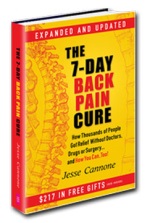
Excerpted from The 7-Day Back Pain Cure
by Jesse Cannone
You've probably heard several of these myths spoken as fact. Perhaps you, your friend, or even your doctor has used these personally. To treat back pain, we have to figure out and treat the underlying problem causing the pain. But before we can do that, it is 100% essential that we dispel these popular myths.
Myth #1: You "Throw Out" Your Back
In the course of my work, I’ve taught hundreds of thousands of people my back-pain treatment approach. When I ask them what’s wrong, they almost always say something like, "I was doing X when I ‘threw out’ my back.”
Usually, some physical activity precedes the back pain, like picking up a heavy object, sneezing, bending over, or getting out of bed. The thinking goes, "Well. since I didn’t have pain before the activity, the activity must have caused the pain.”
As you’ll see in the next few chapters, the reality is a bit more complicated. In many cases, a physical activitycan trigger a pain episode, but by itself, it isn’t the underlying cause.
Consider this example: Let’s say you fill a room with natural gas and then toss a match inside. You could say that the match caused the explosion, but it would be more accurate to say the match "triggered” or ignited the explosion. The better question to focus on is "Where did all that gas come from in the first place?”
It’s very similar with back pain. A physical activity can trigger a pain episode, but it’s not the "fuel” behind it. If you don’t get rid of the underlying problem, then any number of things can "trigger” the pain.
Myth #2: Back Pain Means Something is Wrong with the Back
People usually think that if they have back pain, their bodies are suffering from some mechanical dysfunction. "Since my body hurts,” they say, "it must mean something is wrong with my body–something with the bones, the muscles, or the soft tissue that connects them.”
While this is sometimes, if not often, the case, it’s not the only underlying cause of back pain. Other factors that originate in your mind (e.g., stress levels), as well as your diet (unhealthy foods), can cause severe back-pain episodes, even when there’s nothing wrong with your spine, discs, joints, muscles, or ligaments. These factors also can exacerbate physically caused back pain, making it many times more painful.
Myth #3: The Current Pain isn’t Related to Previous Bouts
If you experienced a back-pain episode two months ago and another today, you’re likely to think these episodes are unrelated. Perhaps the last time it happened because you sneezed. This time you were moving furniture.
For most people, the trigger that causes their pain episode is different on different occasions. Naturally, they associate the "cause” to the trigger and believe the episodes are unrelated.
In fact, in the vast majority of cases, multiple back-pain episodes are usually caused by the same underlying problem–even if each pain episode had a different trigger.
Myth #4: Being Overweight is a Major Cause of Back Pain
Being overweight can contribute to back pain, but in most instances, it's only a minor cause of it. That's because the spine and the back muscles are designed to carry the body, small or large. Our muscles may have to work harder to carry and move around extra poundage, but as long as everything is in balance, that extra weight shouldn't be the major cause of any back pain.
While being overweight is usually not the reason a person has back pain, it can create an extra burden for those who do have back problems–making it a little more difficult to exercise and move around when pain strikes.
Myth #5: People Who are Not Active are More Likely to Have Back Pain
Because active people are perceived to be stronger than inactive people, it's believed that they are less likely to have injuries or illnesses which would cause back pain. Surprisingly, that's not true at all. In fact, the opposite is true–people who are most active suffer from back pain more often than couch potatoes. Not only are they more likely to have back pain, but their back pain is more frequent and at higher levels than their inactive counterparts.
When we think of inactive people, we tend to envision weakness–weak muscles, endurance, etc. However, active people and athletes conjure a different image–one of strength and power. The misconception relating to back pain, though, is because most back pain isn't caused by weakness–it's caused by muscle imbalances, injuries, or illness.
Myth #6: The Best Thing for Back Pain is Bed Rest
Severe back pain may constitute the need for limited mobility and bed rest, but in the long run, significant bed rest can actually cause more pain and problems. Faster healing occurs when you take measures to treat the cause. This includes exercise and activities to increase your blood flow, range of motion, and flexibility.
Too much time spent in bed can prolong your pain and healing time. It can also cause muscles to weaken over time, resulting in an increased chance for further injury. So, some activity is encouraged, even if it's just getting out of bed and walking to a chair and sitting up for half an hour. It will help keep you mobile and limber, and it will make your recovery shorter and more tolerable.


Dr. Brian Paris
Dr. Brian Paris, D.C. is the Medical Advisory Board Lead at The Healthy Back Institute. With over 20 years of clinical experience in pain management and postural restoration, Dr. Paris empowers patients to live pain-free without drugs or surgery.

Related Articles
Recommended Reading
Dietary Fixes That Ease Back Pain Fast
Inflammation is a BIG reason so many people around the world are suffering from back pain right this very minute. In…

7-Day Back Pain Cure Recommended Resources
Short-Term Pain Relief Treatments Natural Pain-Relief Supplements Heal-n-Soothe® Heal-n-Soothe ® is a combination of…

Spinal Stenosis Action Plan
Spinal stenosis is a condition in which the spinal canal narrows, compressing or "squeezing” the spinal cord and nerves…
Sign Up Now For LESS PAIN, MORE LIFE Our FREE E-Newsletter…
Kiss your pain goodbye when you sign up to receive our free, LIVE PAIN FREE email newsletter, which is always full of the latest and most powerful, pain relieving information from the world's leading pain relief experts.
Reader Comments & Discussion (6)
Leave a Comment ↓