
Does Your Spinal Stenosis Require Fusion Surgery?

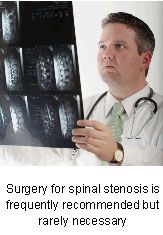
Has chronic back pain been a part of your life for as long as you can remember? Are you still struggling to find a treatment that works? If so, you should speak with your physician and request a check for spinal stenosis. Often the initial diagnosis for a back problem is wrong. Not because the physician is incompetent but because we are constantly learning more and more about back problems like spinal stenosis.
If however, your physician or surgeon recommends spinal fusion surgery you may want to get a second opinion.
What Is Spinal Stenosis?
Spinal stenosis is simply a narrowing of the spinal canal that puts pressure on the spinal cord and the nerves surrounding the spine. This problem most often occurs in the cervical and lumbar regions of the spine and can lead to lower back pain and muscle numbness and weakness.
Not all patients with spinal stenosis suffers from back pain, which is astonishing when you consider that about 20% of adults experience back pain by the age of 40. That problem increases with age for that 20% with almost half of them experiencing a narrowing of the spinal column. Despite these small numbers, fusion surgery is almost always the recommended treatment for spinal stenosis.
For decades elderly patients suffering from spinal stenosis have experienced a growth in surgical recommendations as the main form of treatment. In fact a 2010 study indicates that the number of spinal fusion surgeries for spinal stenosis patients has risen sharply.
When it comes to spinal surgery, the same study found three basic categories of back surgery used:
- Decompression surgery — The bone is cut away from the area which it is pressing on the nerves in the spine.
- Fusion surgery (simple) — two vertebra are fused together permanently using a bone graft and possibly plates and screws.
- Fusion surgery(complex) — 3 or more vertebra are fused together or the vertebra are fused on the front and back of the spine
The most disturbing fact about this is that the costliest of most invasive of these 3 procedures–complex fusion surgery–is the one recommended and used 15 times more than the others.
Of course it’s possible that surgeons recommend this form of treatment because it produces the best results, unfortunately that is not the case. Thirteen percent of complex fusion surgery patients return within 30 days to the hospital for additional care and 20% of them need more surgery within a decade. The worst part of all is that these patients are an increased risk of post-surgical complications in the month after surgery.
What I hope you’ve gotten from this is that any form of spinal surgery is incredibly risky, especially when the low rate of success is factored into the equation. Just because your doctor recommends surgery does not make it the best solution for you, nor does is guarantee a successful outcome. There are other, less invasive, methods of treatment that should always be tried before surgery becomes an option.
Many spinal stenosis cases are just a result of aging, with a number of spinal problems contributing to its development such as a herniated disc, osteoporosis, calcification over-growth, and scar tissue build up. Because of this, we recommend using natural pain relief treatments for spinal stenosis as they have a high rate of success.
Nutrition is where you should begin your spinal stenosis treatment. You may get enough calcium through your diet as well as supplements, but oddly enough very few people get enough magnesium and vitamin D which can help balance the absorption of minerals.
Scar tissue buildup is often the result of chronic inflammation and excess fibrin. Both can be eliminated through the use of proteolytic systemic enzymes. There are many natural methods of getting these enzymes.
Correcting muscle imbalances that cause herniated discs will help restore the muscle balance thereby relieving pressure on the spinal discs. Even spinal decompression is a painless yet effective treatment. An inversion table or the Nubax can help decompress without a costly and risky surgery.
Lastly it is important that you know that spinal stenosis doesn’t automatically mean the origin of your pain is the spine, since we now know that a majority is caused by trigger points deep in the muscle tissue.

Dr. Brian Paris
Dr. Brian Paris, D.C. is the Medical Advisory Board Lead at The Healthy Back Institute. With over 20 years of clinical experience in pain management and postural restoration, Dr. Paris empowers patients to live pain-free without drugs or surgery.

Related Articles
Recommended Reading
Unnecessary Back Surgery Procedure Causes Death
An Important and Disturbing Example Why You Must Beware of Back Surgery! In 2010, 68-year-old Lillian Kaulback had…

Fusion Surgery: Blowing the Whistle
It's time we set something straight once and for all. Back fusion surgery is crippling those with back pain. And it…

These 6 Bad Habits Are Making Your Knee Pain WORSE
BREAKING NEWS : Research Reveals the “Holy Trinity” Miracle for Super Fast and Everlasting Joint Relief Nearly 20…
Sign Up Now For LESS PAIN, MORE LIFE Our FREE E-Newsletter…
Kiss your pain goodbye when you sign up to receive our free, LIVE PAIN FREE email newsletter, which is always full of the latest and most powerful, pain relieving information from the world's leading pain relief experts.
Reader Comments & Discussion (8)
Leave a Comment ↓