
Is Facet Joint Syndrome Causing Your Neck & Back Pain?

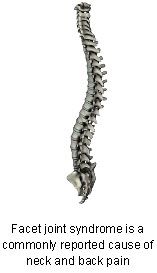
Facet joints are those that connect the vertebra allowing you to twist and bed, thanks to their slick surface. Even more important however, facet joints work to avoid spinal cord injuries by disallowing us from twisting or bending too far. This inhibited range of motion is a protective measure for the spinal cord.
When facet joints are hurt, your ability to move regularly and without pain can suffer. A cervical facet joint may restrain your neck, thereby rendering you unable to stand with proper posture and further exacerbating the pain. If you’ve ever experienced neck pain that forces you to move your entire body to see items to your left and right, you may have an injured facet joint.
Pain due to an injury to the lumbar facet joint can cause symptoms that include an inability to stand up straight, causing poor posture. If you experience agonizing pain starting in the buttocks and trailing down to the thighs, you might have what physicians refer to as common facet joint syndrome.
These facet joints commonly cause neck and back pain, but very few patients and doctors are aware of this syndrome. This is why it is so important to understand how the body works and how many different back problems truly exist. More than one-third of chronic back pain can be attributed to lumbar facet joints and about half of all neck pain complaints that are not due to a herniated disc.
But before self-diagnose your neck or back pain as facet joint syndrome, you should know that a cause is not a syndrome. While it may cause your pain, it is likely that there are underlying issues causing the pain. Doctors often use an injection known as a facet joint block to isolate the primary source of pain, which is then used to treat the pain as well.
Facet joint pain is a symptom of a much larger problem and while ending the pain is probably your primary concern, the only way to keep the neck or back pain from returning is to find and treat the underlying cause.
The root problem causing pain will differ from one individual to the next and there isn’t one treatment that will prove effective for everyone. Treatment will take some effort and a coordinated effort between you, your pain specialist and your physician. The time and effort it takes to treat the problem will relieve pain and it will be worth it.
Short-Term Pain Relief
Short term pain relief for facet joint syndrome will allow you a sufficient range of motion while you locate and treat the root problem. Try these treatments for immediate relief:
Heat Therapy will give you a deep penetrating heat down to your muscles that can alleviate the ache. My recommendation is to try a far infrared heating pad which can penetrate deeper than a traditional heating pad for effective pain relief.
Celadrin-Based Pain Cream - while many over the counter creams may help for a few minutes at a time, Celadrin is the only pain relief cream ingredient with a 100% success rate in relieving joint pain.1
Natural Anti-Inflammatories will reduce the swelling commonly associated with painful facet joints. A healthy alternative to dangerous and habit-forming NSAIDs are natural anti-inflammatories.
Treating The Root Problem
Muscle Balance Therapy - Restoring your body to a balanced and constant state is vital to long-term pain relief. That’s what muscle balance therapy helps you accomplish.
Trigger Point Therapy - Trigger points have been proven to be directly responsible for the majority of all pain. By eliminating trigger points your pain relief will become a priority in the treatment phase.
Inversion Therapy - Inversion therapy can help correct misaligned facet joints by relieving pressure on the joints so they "slip” back into the proper position.
Diet - Avoid foods that can contribute to or worsen inflammation such as foods high in salt, fat, or sugar as well as any processed foods and refined grains. A diet filled with fresh fruits and vegetables can help, but if you have dietary restrictions you may want to consider a multi-vitamin.
De-Stress - When all else fails, evaluate your emotional state and how you handle every day stress. In some instance an emotional unbalance can render even the most effective treatments, ineffective. Recognize that facet joint syndrome is a problem–a treatable problem–and find a way to handle exterior stressors and you’ll notice your pain quickly becoming a thing of the past.
Here’s a video you might find helpful.
Related references:
1 Kraemer WJ, et al. Effect of a cetylated fatty acid topical cream on functional mobility and quality of life of patients with osteoarthritis. The Journal of rheumatology. 2004 Apr;31(4):767-74.

Dr. Brian Paris
Dr. Brian Paris, D.C. is the Medical Advisory Board Lead at The Healthy Back Institute. With over 20 years of clinical experience in pain management and postural restoration, Dr. Paris empowers patients to live pain-free without drugs or surgery.

Related Articles
Recommended Reading
These 6 Bad Habits Are Making Your Knee Pain WORSE
BREAKING NEWS : Research Reveals the “Holy Trinity” Miracle for Super Fast and Everlasting Joint Relief Nearly 20…

Our Social Media
Stay connected Follow the Healthy Back Institute Join our community for natural pain-relief tips, wellness guidance,…
Are Off-Label Peptides Safe? The Gray Market Risk Explained
In the quest for youth, muscle gain, and relief from the symptoms of aging, it is tempting to chase the "next big…
Sign Up Now For LESS PAIN, MORE LIFE Our FREE E-Newsletter…
Kiss your pain goodbye when you sign up to receive our free, LIVE PAIN FREE email newsletter, which is always full of the latest and most powerful, pain relieving information from the world's leading pain relief experts.
Reader Comments & Discussion (3)
Leave a Comment ↓